
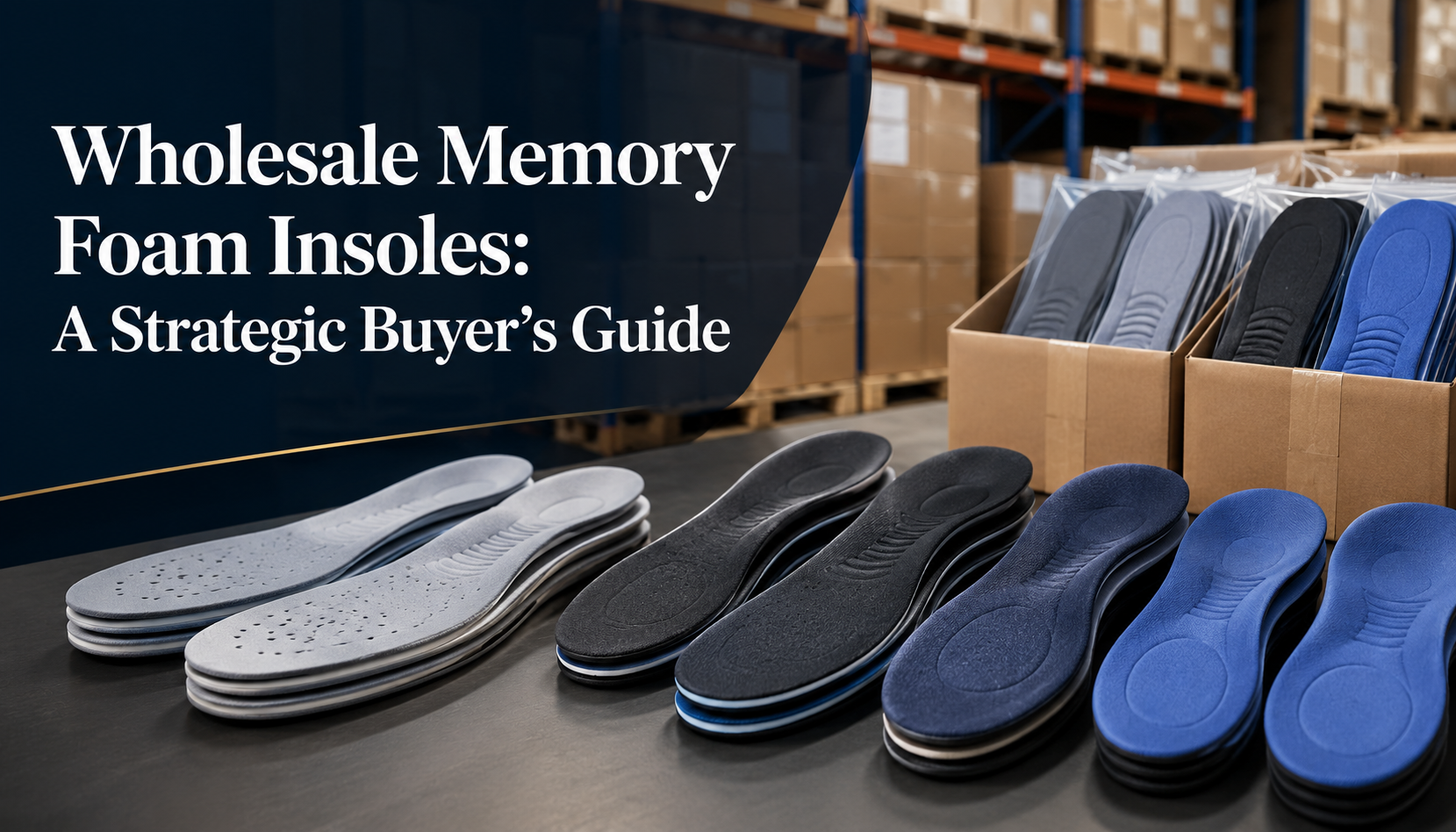
Wholesale memory foam insoles can provide retailers, distributors, footwear stores, online sellers, and regional importers with an accessible comfort category. The product addresses a clear consumer need and can be offered alongside casual shoes, work footwear, sports products, travel accessories, and general foot-care items.
A successful wholesale program requires more than purchasing large quantities at the lowest available price. Material performance, sizing, packaging, order consistency, positioning, and supplier communication all influence commercial results. Wholesale value is created when product reliability and operational planning work together.
Buyers should therefore approach memory foam insoles as a complete retail category. The objective is to select products that customers can understand, sales teams can explain, and supply chains can replenish with confidence.
Why Memory Foam Insoles Work as a Retail Category
Insoles are practical products with a straightforward purpose. Customers often seek them when existing footwear feels too firm, factory inserts have become worn, or daily routines involve long periods of walking and standing. This creates opportunities across physical stores and e-commerce channels.
Memory foam is also easy to communicate because consumers understand the idea of material adapting under pressure. However, expectations must be managed carefully. The strongest retail proposition focuses on cushioning, fit, material quality, and everyday comfort rather than unsupported medical promises.
Commercial advantages may include:
- Compatibility with several footwear categories
- A clear comfort-focused value proposition
- Opportunities for repeat replacement purchases
- Flexible retail and e-commerce presentation
- Multiple size and thickness options
- Potential for private label development
- Cross-selling with shoes and footwear accessories
- Suitability for different customer profiles
Retailers should still provide accurate fitting information. A poorly matched insole can make an otherwise comfortable shoe feel too tight.
Establishing the Product Specification
Before requesting prices, the buyer should define the product clearly. A quotation based only on the phrase “memory foam insole” may not reflect the desired quality because thickness, density, surface fabric, size range, and packaging can vary considerably.
A precise specification makes supplier comparisons more meaningful. It also reduces the risk of receiving samples that differ from the final commercial objective.
The specification may include:
- Polyurethane foam density and firmness
- Overall insole thickness
- Full-length or partial-length format
- Exact-size or trim-to-fit construction
- Surface fabric type and color
- Size range and grading method
- Packaging format
- Barcode and label requirements
- Logo placement
- Order quantity by size
- Intended retail market
The buyer should also state the footwear categories in which the product will be used. This helps the manufacturer recommend an appropriate construction.
Evaluating Samples Before a Bulk Order
Samples should be tested for more than initial softness. The buyer should check how the insole fits different shoes, whether the edges remain flat, how quickly the foam recovers, and whether both units in a pair feel consistent.
Repeated-wear testing provides better information than a short hand-pressure test. An insole that feels impressive for several minutes may perform differently after hours of body-weight compression.
A sample review should cover:
- Dimensional accuracy
- Pair-to-pair consistency
- Surface appearance
- Foam thickness
- Recovery after compression
- Adhesive strength
- Edge quality
- Odor level
- Fit inside target footwear
- Packaging protection
Samples should represent the proposed production specification. Buyers should confirm whether any handmade sample details will change during mass manufacturing.
Quality Control for Wholesale Memory Foam Insoles
Quality control protects both the buyer and the end customer. Inconsistent sizing, uneven foam, weak lamination, or damaged packaging can create returns and damage retailer confidence. A supplier should therefore be able to explain how products are checked during and after production.
Inspection requirements should be agreed before manufacturing begins. Clear acceptance criteria make quality discussions objective and reduce misunderstandings when an order is completed.
Possible inspection points include:
- Length and width tolerances
- Thickness tolerance
- Foam density consistency
- Surface adhesion
- Visual defects
- Cutting accuracy
- Left-and-right pair matching
- Packaging dimensions
- Label accuracy
- Carton quantity
- Barcode readability
- Compression and recovery checks
Large buyers may use pre-shipment inspection or independent quality services. Smaller businesses can still request production photographs, measurement reports, and retained samples.
Packaging and Shelf Presentation
Packaging performs several roles. It protects the insole, communicates product benefits, provides fitting instructions, displays size information, and supports the visual identity of the brand. Poor packaging can make a quality insole appear generic or confusing.
Retail packaging should communicate quickly because shoppers often compare several products at once. The message should explain what the insole is, who it is for, how it fits, and what makes the material different.
Useful packaging content includes:
- Product name
- Material description
- Size or trimming instructions
- Intended footwear uses
- Core comfort benefits
- Care information
- Manufacturer or importer details
- Required compliance information
- Barcode
- Recycling guidance where applicable
Claims should be accurate and proportionate. Medical, therapeutic, or sustainability statements should not be printed without appropriate evidence.
Inventory Planning and Size Distribution
Wholesale orders can create unnecessary stock when size distribution is not based on the target market. A balanced order should consider local footwear sizing, customer demographics, sales channel, season, and the difference between exact-size and trim-to-fit products.
Trim-to-fit models can simplify inventory, but some customers prefer pre-sized products that require no cutting. The correct assortment balances convenience, customer confidence, and warehouse efficiency.
Inventory decisions may cover:
- Best-selling regional shoe sizes
- Men’s, women’s, and unisex presentation
- Exact-size versus grouped-size models
- Minimum order by size
- Reorder lead time
- Seasonal demand
- Carton configuration
- Safety stock
- Online marketplace requirements
- Distributor territory planning
Initial orders should be large enough to test the category properly but controlled enough to avoid excessive exposure. Sales data can then guide future size ratios.
Wholesale, OEM, and Private Label Differences
Wholesale purchasing usually involves an established product or a limited group of options. OEM production allows the product to be developed according to technical requirements, while private label programs add the buyer’s branding and market presentation.
The models can overlap. A retailer may begin with standard wholesale memory foam insoles and later move to customized packaging, foam specifications, or unique shapes. Understanding the level of customization prevents unrealistic expectations during supplier discussions.
Typical differences include:
- Wholesale: established specification, faster selection, limited customization
- Private label: buyer branding, packaging customization, established product base
- OEM: technical development according to buyer requirements
- Contract manufacturing: production based on agreed designs and standards
- Distribution partnership: regional resale and market-development cooperation
FIXAR supports wholesale, footwear manufacturing, OEM, and private label projects, allowing partners to select a model suited to their business stage.
Selecting a Wholesale Supplier
Price is important, but it should be evaluated alongside product consistency, communication, documentation, production capacity, and delivery reliability. An unusually low quotation may reflect a different foam grade, thinner construction, simpler packaging, or reduced quality control.
A dependable supplier should ask questions about the target product rather than immediately offering one universal solution. Professional consultation is a positive signal because insole specifications must match footwear, customers, and market positioning.
Evaluate potential suppliers by reviewing:
- Manufacturing specialization
- Material knowledge
- Sample consistency
- Customization capabilities
- Quality-control procedures
- Packaging support
- Minimum order requirements
- Production lead times
- Export experience
- Communication quality
- Problem-resolution process
- Reorder consistency
The relationship should be structured for repeat business. A successful wholesale program depends on the next order as much as the first.
Building a Profitable Product Range
A single universal insole may not address every customer need. Retailers can organize the range according to activity, thickness, material, price position, or footwear type. Clear differentiation reduces internal competition and helps customers choose.
The assortment should remain manageable. Too many nearly identical products can confuse shoppers and create slow-moving inventory. A focused range with clearly separated benefits is usually stronger than a large collection without meaningful differences.
Possible product groups include:
- Everyday comfort insoles
- Work and standing insoles
- Walking and travel insoles
- Lightweight casual-shoe models
- Premium PU memory foam insoles
- Trim-to-fit entry products
- Private label branded collections
- Footwear-factory components
Sales materials should explain the differences in plain language. Technical details are useful when they connect directly to a customer benefit.
Sık Sorulan Sorular – S.S.S
1. What are wholesale memory foam insoles?
They are memory foam footwear inserts purchased in commercial quantities for resale, distribution, or integration into shoes. Wholesale programs may involve standard products or customized options.
2. Who buys wholesale memory foam insoles?
Typical buyers include footwear stores, distributors, online retailers, shoe brands, workwear suppliers, and private label companies. The best product specification varies by sales channel.
3. What is a normal wholesale minimum order quantity?
Minimum quantities depend on size range, packaging, customization, and manufacturing method. Standard products usually require lower commitments than fully customized designs.
4. Should buyers request samples first?
Yes, samples allow the buyer to evaluate fit, foam response, surface quality, dimensions, and packaging. Bulk production should not be approved solely from photographs.
5. What specifications should be provided to a supplier?
Buyers should define thickness, foam type, firmness, size range, surface fabric, packaging, branding, and intended footwear. Clear specifications improve quotation accuracy.
6. Are trim-to-fit insoles suitable for wholesale?
They can simplify size management and appeal to broad customer groups. Packaging must provide clear cutting and fitting instructions.
7. What is the difference between wholesale and private label?
Wholesale usually involves an existing product, while private label places the buyer’s branding on an agreed product. Additional customization may require larger quantities and longer development.
8. Can wholesale insoles be customized?
Many manufacturers offer customization for foam, thickness, shape, fabric, color, logo, and packaging. The available options depend on order volume and production capability.
9. How should wholesale quality be checked?
Inspection can cover dimensions, foam consistency, bonding, cutting, pair matching, packaging, and labeling. Buyers should agree on acceptance standards before production.
10. Why is foam recovery important for retailers?
Recovery influences how long cushioning remains useful after repeated compression. Weak recovery can lead to customer dissatisfaction and early replacement complaints.
11. How should size quantities be planned?
The size mix should reflect regional footwear demand, customer demographics, and sales data. Trim-to-fit sizing may reduce the number of individual stock units.
12. What information belongs on retail packaging?
Packaging should state the product type, size, material, benefits, fitting method, care instructions, and required commercial information. Claims must be accurate and supportable.
13. Can memory foam insoles be sold online?
Yes, but online listings need precise dimensions, sizing guidance, thickness information, and footwear compatibility details. Clear content helps reduce unsuitable purchases.
14. Are wholesale insoles profitable?
Profitability depends on purchase cost, freight, packaging, marketplace fees, returns, competition, and selling price. Buyers should calculate total landed cost rather than considering factory price alone.
15. How important is the supplier’s production capacity?
Capacity becomes important when demand grows or several sizes must be produced simultaneously. Buyers should confirm whether the supplier can support consistent repeat orders.
16. Should the cheapest supplier be selected?
Not automatically, because lower prices may reflect different materials or quality controls. Samples and complete specifications should be compared before a decision is made.
17. Can wholesale insoles be supplied to footwear factories?
Yes, manufacturers may purchase insoles as components for integration into finished shoes. Factory use often requires tighter dimensions and production-line compatibility.
18. What documents may international buyers require?
Requirements vary by country, product classification, packaging, and material claims. Importers should confirm applicable customs, labeling, safety, and commercial documentation.
19. How can retailers reduce returns?
They can provide accurate sizing, thickness, trimming, and shoe-compatibility instructions. Staff and online content should explain that adding an insole reduces internal shoe space.
20. Why consider FIXAR for wholesale supply?
FIXAR focuses on polyurethane memory foam insoles and supports retailers, distributors, footwear brands, OEM partners, and private label businesses. This allows wholesale relationships to develop toward more customized programs when required.
Bir yanıt yazın