
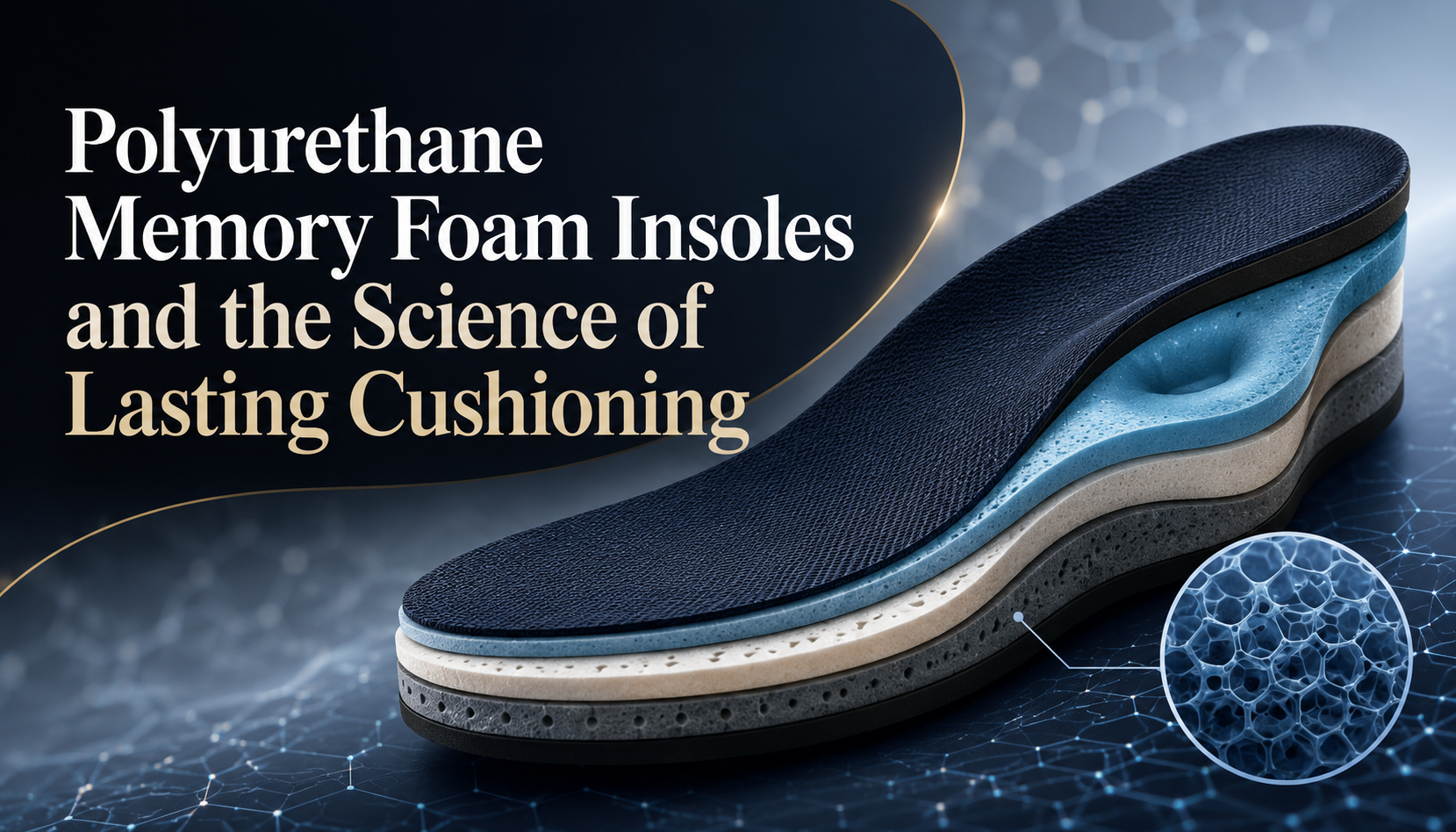
A comfortable insole must do more than feel soft when it is first touched. It must respond predictably when exposed to body weight, repeated steps, bending, heat, and many hours inside footwear. Polyurethane memory foam insoles are developed to provide adaptive cushioning while maintaining a controlled level of resilience.
Polyurethane, commonly shortened to PU, can be formulated with different densities, firmness levels, recovery characteristics, and cell structures. These variables allow manufacturers to design insoles for distinct footwear categories rather than relying on one standard type of foam. The value of polyurethane memory foam comes from its capacity to combine pressure response with repeatable everyday performance.
Material selection is especially important for footwear brands, retailers, and users who expect cushioning to remain useful beyond the first few days. Understanding how PU memory foam behaves makes it easier to evaluate quality and choose an insole suited to the intended application.
What Polyurethane Memory Foam Is
Polyurethane memory foam is a viscoelastic material, which means its response includes both cushioning and gradual recovery. Under pressure, the foam compresses and adapts to the load. When the load is removed, it moves back toward its previous form rather than springing back instantly like a highly elastic material.
The precise feeling depends on the formulation. Some PU foams are soft and slow-recovering, while others are firmer and more responsive. A footwear-grade formulation should be selected according to the desired balance of comfort, stability, thickness, and durability.
Important design variables include:
- Foam density
- Indentation firmness
- Recovery speed
- Compression-set resistance
- Cell structure
- Insole thickness
- Temperature response
- Bonding compatibility with upper fabrics
These characteristics should be considered together. A high value in one area does not guarantee that the complete insole will perform well inside a shoe.
How PU Memory Foam Manages Pressure
Walking and standing create changing pressure beneath the foot. The heel receives concentrated contact during landing, while the forefoot carries substantial load during push-off. A responsive foam layer can compress around these areas and create a broader contact surface.
This does not mean the insole removes all pressure. Instead, the material helps moderate the interface between the foot and the shoe. Controlled deformation can make footwear feel less harsh while preserving a stable base for daily movement.
Key pressure-management functions include:
- Cushioning concentrated contact zones
- Adapting to variations in foot shape
- Reducing the abrupt feeling of hard internal surfaces
- Supporting a smoother transition through each step
- Maintaining contact as the foot moves
- Recovering when pressure is released
The final sensation also depends on the shoe’s midsole, outsole, shape, and fit. An insole should be treated as one part of the complete footwear system.
Compression Recovery and Long-Term Performance
Compression recovery describes the material’s ability to regain shape after being loaded. It is one of the most important characteristics in an insole because repeated body weight can gradually cause low-quality foam to remain flattened.
A product with poor recovery may initially feel plush but become thin and ineffective. Better recovery helps preserve cushioning depth and reduces the difference between early use and later use. For long-term value, the foam’s behavior after hundreds of compression cycles matters more than showroom softness.
Signs of effective recovery include:
- The heel area does not remain permanently indented
- The foam regains thickness after the shoe is removed
- Cushioning remains relatively consistent across repeated wear
- The insole does not develop severe uneven zones
- The edges retain their intended structure
- The material remains bonded to the surface layer
Density alone does not determine recovery. Formulation, processing, curing, thickness, and production control all influence the result.
PU Memory Foam Compared with EVA and Silicone
EVA is widely used in footwear because it is lightweight, flexible, and economical. It can provide effective cushioning, but its response is usually more immediate and elastic than memory foam. Different EVA grades also vary considerably in durability and compression resistance.
Silicone and gel materials can provide localized impact cushioning, but they may feel heavier and less breathable in some constructions. Polyurethane memory foam is often selected when a manufacturer wants a more adaptive, full-surface cushioning sensation. The correct material depends on the product objective rather than a universal ranking.
A practical comparison includes:
- PU memory foam: adaptive feel, controlled compression, customizable density
- EVA foam: lightweight structure, responsive cushioning, broad cost options
- Silicone or gel: concentrated cushioning, high material weight in some designs
- Latex foam: elastic response, ventilation potential, distinct material feel
- Hybrid systems: combined layers designed for balanced performance
Many premium insoles use more than one material. A supportive base may be paired with a softer upper layer to deliver both structure and comfort.
Breathability and Moisture Considerations
Foam cell structure can influence how air and moisture move through an insole. Open-cell PU formulations may allow more airflow than tightly closed structures, but overall breathability also depends on the covering fabric, adhesives, perforations, shoe upper, and sock material.
No insole can create full ventilation inside an unsuitable shoe. However, thoughtful material selection can reduce the heavy, sealed feeling associated with poorly designed inserts. Breathability should be evaluated as part of the complete construction rather than attributed to the foam alone.
Factors that influence the internal climate include:
- Open-cell or closed-cell foam structure
- Surface textile composition
- Perforation patterns
- Adhesive coverage
- Shoe ventilation
- Sock material
- Duration of wear
- Opportunities for drying between uses
Removing insoles after long wear periods allows moisture to escape and gives the foam time to recover.
Density, Firmness, and Thickness
Density refers to the amount of material contained within a given volume of foam. Firmness describes the resistance felt when the foam is compressed. These values are related but not identical, so a dense foam is not automatically extremely firm.
Thickness determines how much material is available to compress, but additional thickness can create fit problems. The best specification is the one that achieves the intended cushioning effect without reducing usable shoe volume.
Manufacturers and buyers should evaluate:
- Target footwear type
- Available internal depth
- User activity level
- Expected duration of wear
- Required cushioning sensation
- Desired recovery profile
- Product weight
- Target retail position
A casual shoe may use a different specification from a work boot, athletic shoe, or low-volume formal design.
Construction Quality Beyond the Foam
The foam is central to performance, but the complete insole also includes a surface, adhesive system, shape, edge finish, and sometimes additional structural layers. Weak bonding can cause separation even when the foam itself remains functional.
The upper fabric affects initial touch, moisture behavior, friction, and appearance. Cutting accuracy influences whether the product sits flat inside the shoe. Premium performance requires coordinated material engineering rather than relying on one impressive component.
Quality indicators include:
- Uniform foam thickness
- Clean and accurate cutting
- Stable bonding between layers
- Surface materials suited to regular wear
- Smooth transitions around shaped sections
- Consistent dimensions between pairs
- Controlled packaging that prevents deformation
- Repeatable feel across production batches
For commercial buyers, consistency is particularly important because customers expect the same product experience from every unit.
Applications for Polyurethane Memory Foam Insoles
PU memory foam can be developed for a wide range of footwear categories. The formulation and design should change according to the amount of space, movement, pressure, and durability expected in each application.
FIXAR develops polyurethane memory foam insoles for everyday users and also supports footwear brands through industrial, wholesale, OEM, and private label production. This manufacturing flexibility allows product specifications to be aligned with different customer groups and commercial objectives.
Potential applications include:
- Everyday casual shoes
- Work and service footwear
- Walking shoes
- Travel footwear
- Light training shoes
- Retail replacement insoles
- Private label comfort products
- Factory-integrated footwear components
The same foam specification should not automatically be used for every category. Product development should begin with the intended shoe and wearer.
Sık Sorulan Sorular – S.S.S
1. What are polyurethane memory foam insoles?
They are footwear inserts made with PU-based viscoelastic foam. The material compresses under pressure and gradually recovers after the load is removed.
2. What does PU mean in insoles?
PU is an abbreviation for polyurethane. It is a versatile polymer that can be formulated into foams with different densities, firmness levels, and recovery characteristics.
3. Why is polyurethane used for memory foam?
Polyurethane allows manufacturers to control cushioning, adaptation, and resilience through formulation. This flexibility makes it suitable for many footwear comfort applications.
4. Are PU memory foam insoles durable?
High-quality PU memory foam can provide dependable durability when formulation and production are properly controlled. Actual lifespan also depends on use, moisture, thickness, and body weight.
5. What is compression recovery?
Compression recovery is the foam’s ability to regain shape after pressure is removed. It helps an insole maintain useful cushioning across repeated wear.
6. Is higher-density foam always better?
No, because density must match the footwear and intended comfort profile. Excessively dense foam may feel too firm, while unsuitable low-density foam may compress too quickly.
7. Are PU insoles better than EVA insoles?
Each material serves different objectives. PU memory foam often provides a more adaptive feeling, while EVA is commonly selected for lightweight and responsive cushioning.
8. Are polyurethane insoles heavy?
Their weight depends on density, thickness, size, and additional layers. A well-designed PU insole can remain practical for everyday footwear.
9. Do PU memory foam insoles absorb impact?
They can moderate the sensation of impact by compressing under load. Performance depends on the foam formulation and the construction of the entire shoe.
10. Are polyurethane memory foam insoles breathable?
Open-cell formulations may support airflow, but breathability also depends on the fabric, adhesive, perforations, socks, and footwear. The complete system should be evaluated.
11. Does temperature affect memory foam?
Temperature can influence softness and recovery speed in some formulations. The extent of the change depends on the specific polyurethane chemistry.
12. Can PU memory foam flatten permanently?
All cushioning materials can deteriorate under repeated stress. Premium formulation and effective compression recovery can delay permanent flattening.
13. How thick should a PU memory foam insole be?
The correct thickness depends on available shoe space and desired cushioning. It should improve comfort without raising the foot excessively.
14. Can polyurethane memory foam be customized?
Yes, manufacturers can adjust density, firmness, thickness, shape, surface materials, and other features. Customization is commonly used in OEM and private label production.
15. Are PU insoles suitable for work shoes?
They can be appropriate for compatible work footwear that offers sufficient internal space. The insole must not interfere with secure fit or required safety features.
16. What surface materials can be added to PU foam?
Possible options include textiles selected for comfort, friction, moisture management, or branding. Material compatibility and bonding quality must be tested.
17. Can PU memory foam be combined with other materials?
Yes, hybrid insoles may combine memory foam with supportive bases, textiles, EVA, or other functional layers. Each combination should be designed around a clear performance goal.
18. How is PU insole quality evaluated?
Buyers can examine density consistency, compression behavior, recovery, bonding, dimensions, surface quality, and repeated-wear performance. Sample testing is particularly important for commercial orders.
19. Are polyurethane insoles medical products?
Standard comfort insoles are not automatically medical devices. Products intended for clinical claims or medical use may require different design, testing, and regulatory processes.
20. Why choose FIXAR polyurethane memory foam insoles?
FIXAR concentrates on PU memory foam technology, everyday comfort, production consistency, and scalable manufacturing. Its positioning also supports wholesale, OEM, and private label footwear projects.
Bir yanıt yazın