
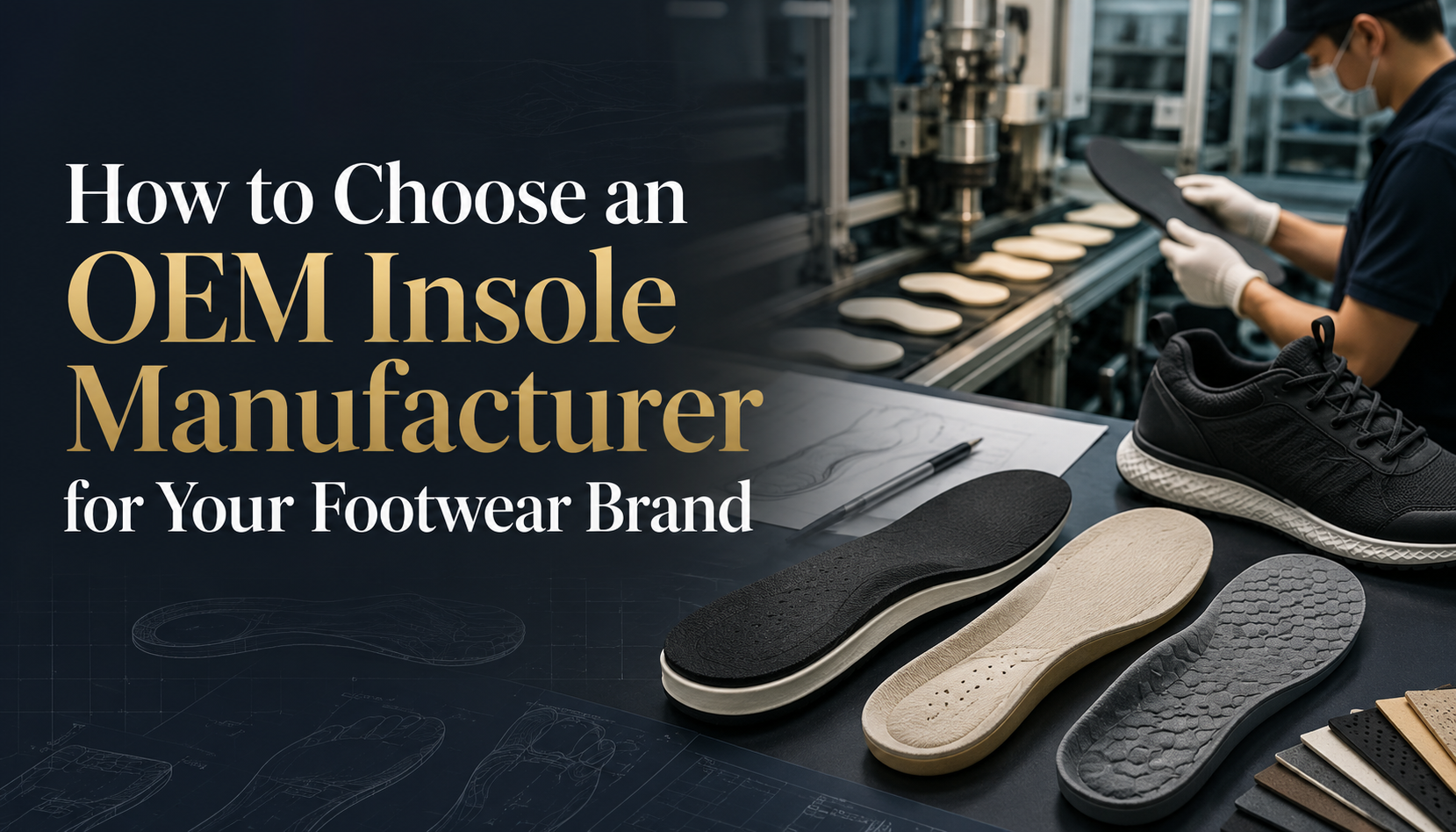
Selecting an OEM insole manufacturer is a strategic decision because the insole directly influences how customers experience the finished shoe. Even when the upper and outsole are well designed, inconsistent cushioning, poor fit, weak bonding, or premature compression can reduce perceived product quality.
An OEM relationship should connect product design with repeatable manufacturing. The supplier must understand materials, dimensions, production tolerances, branding, packaging, order planning, and the commercial objectives behind the footwear collection. The strongest manufacturing partner does not simply accept an order, but helps translate a product concept into a controlled specification.
Footwear brands should evaluate potential partners through a structured process. This reduces development delays and provides a clearer basis for comparing samples, costs, and capabilities.
What an OEM Insole Manufacturer Does
OEM manufacturing involves producing insoles according to specifications agreed with another company. The customer may define the shape, dimensions, materials, performance level, surface fabric, branding, packaging, or intended footwear category.
The manufacturer then develops or adapts the production process to meet those requirements. OEM production is most valuable when the finished insole must fit a particular shoe and support a distinct brand promise.
OEM services may include:
- Product consultation
- Material recommendations
- Technical drawing review
- Foam-density selection
- Thickness development
- Shape and size grading
- Surface-material sourcing
- Logo application
- Prototype production
- Quality-control planning
- Packaging preparation
- Scaled manufacturing
The exact division of responsibility should be documented. Some buyers provide complete designs, while others need greater development support.
OEM Production and Private Label Manufacturing
OEM and private label are related but not identical. In a private label arrangement, a manufacturer may offer an established insole that is sold under the customer’s brand. OEM projects generally involve more technical customization.
Private label can be appropriate for businesses seeking faster market entry. OEM is more suitable when the insole must match a unique footwear structure or differentiated performance objective. Choosing the correct model helps control development cost, minimum order quantity, and launch timing.
Typical characteristics include:
- Private label: existing design with custom branding
- Modified private label: established design with selected changes
- OEM: production based on buyer-specific technical requirements
- Original design partnership: joint product development
- Footwear component supply: insoles delivered for factory integration
A company may begin with private label and move toward OEM after gaining sales data and customer feedback.
Preparing an Effective Product Brief
A vague request such as “we need a comfortable memory foam insole” is not enough for accurate development. Comfort depends on measurable and design-specific factors, including thickness, firmness, shape, shoe volume, and intended activity.
The brief should explain both technical requirements and commercial positioning. Manufacturers make better recommendations when they understand who will wear the product, how it will be sold, and what problem it is intended to solve.
A useful brief includes:
- Target footwear category
- Customer profile
- Required size range
- Insole dimensions
- Available shoe volume
- Foam material preference
- Target firmness and thickness
- Desired surface fabric
- Branding requirements
- Packaging format
- Planned order quantity
- Target market and price level
- Testing expectations
- Launch schedule
Reference samples can be useful, but the buyer should explain which characteristics should be retained and which should be changed.
Assessing Material Expertise
An OEM insole manufacturer should be able to explain the practical differences between polyurethane memory foam, EVA, silicone, textiles, adhesives, and structural layers. Recommendations should be connected to the footwear objective rather than based only on available stock.
For polyurethane memory foam insoles, the supplier should discuss density, firmness, recovery, thickness, cell structure, surface lamination, and expected use. Material expertise is demonstrated through clear trade-offs, not through claims that one formula is perfect for every application.
Useful questions include:
- Which foam formulations suit the target shoe?
- How does firmness change with thickness?
- What recovery behavior should be expected?
- Which fabric works with the intended environment?
- How are layers bonded?
- What happens under moisture and heat exposure?
- Can the material be adjusted for future orders?
- How is batch consistency monitored?
A knowledgeable supplier should also identify when the requested specification may create fit, durability, or production problems.
Prototyping and Sample Development
Prototypes convert written specifications into physical products. They allow the brand to evaluate dimensions, comfort, visual quality, shoe integration, and production feasibility before committing to a bulk order.
One sample round may not be enough. Adjustments to thickness, edges, heel shape, fabric, or firmness may be needed after wear testing. A disciplined approval process is less expensive than correcting an unsuitable specification after mass production.
A prototype review can include:
- Fit within the intended shoe
- Left-and-right consistency
- Toe and heel dimensions
- Foam response under body weight
- Surface friction
- Edge transitions
- Layer adhesion
- Logo quality
- Packaging fit
- Wear-test feedback
- Manufacturing feasibility
- Expected unit cost
The final approved sample should be clearly identified and retained by both parties as a production reference.
Quality Assurance and Production Control
Quality assurance begins before manufacturing, not after the order is finished. Specifications, tolerances, approved materials, test methods, and inspection responsibilities should be confirmed in advance.
The manufacturer should have controls for incoming materials, in-process production, finishing, pair matching, packaging, and shipment preparation. Repeatable quality is especially important for footwear brands because one inconsistent component can affect an entire shoe collection.
A quality plan may cover:
- Material verification
- Foam density or firmness checks
- Dimensional tolerances
- Thickness measurements
- Surface adhesion
- Cutting accuracy
- Pair consistency
- Logo placement
- Packaging accuracy
- Carton counts
- Retained production samples
- Pre-shipment inspection
Brands should determine which defects are critical, major, or minor. This provides a practical framework for inspection decisions.
Branding and Packaging Capabilities
Private label and OEM insoles often require logos, printed surfaces, woven labels, packaging graphics, inserts, barcodes, or market-specific language. These elements must be coordinated with technical production because branding methods can affect materials and lead times.
Packaging should protect the product and communicate its purpose. A technically strong insole may still underperform commercially when branding and instructions do not explain its value clearly.
Customization may involve:
- Printed or embossed logos
- Custom surface colors
- Branded top fabrics
- Product names
- Retail boxes or sleeves
- Instruction cards
- Barcode labels
- Size stickers
- Multilingual text
- Shipping cartons
- E-commerce packaging
- Distributor-specific labels
Buyers should approve artwork, colors, dimensions, and placement before production. Regulatory wording should also be reviewed for the destination market.
Capacity, Lead Time, and Scalability
A manufacturer may produce an excellent prototype but struggle with commercial volume. Brands should confirm realistic capacity, production scheduling, material availability, and lead times for repeat orders.
Scalability is not only about producing more units. It includes maintaining the same foam, dimensions, bonding, appearance, and packaging as volume increases. Growth becomes sustainable when production capacity and quality systems expand together.
Operational questions should address:
- Minimum order quantities
- Monthly production capacity
- Tooling requirements
- Material procurement time
- Sample lead time
- Bulk production lead time
- Peak-season capacity
- Packaging capacity
- Reorder scheduling
- Export preparation
- Delivery terms
- Contingency planning
Forecast sharing can help manufacturers prepare materials and reserve production capacity. Confidentiality and commercial data handling should be addressed when necessary.
Communication and Partnership Quality
OEM projects involve many decisions, so communication quality directly affects outcomes. The supplier should provide clear responses, identify risks, document changes, and confirm approvals before proceeding.
Fast responses are useful, but accurate responses are more important. A reliable partner communicates problems early rather than hiding them until the delivery date.
Positive partnership signals include:
- Detailed questions about the product
- Written confirmation of specifications
- Transparent sample revisions
- Clear cost breakdowns
- Realistic lead times
- Organized artwork approval
- Regular production updates
- Documented quality standards
- Practical problem solving
- Consistency across repeat orders
FIXAR’s positioning as an OEM insole manufacturer combines polyurethane memory foam knowledge with wholesale, private label, and footwear-industry production support.
Final Manufacturer Selection Checklist
The final decision should not be based on price alone. Samples, technical competence, capacity, quality controls, communication, and commercial compatibility should be reviewed together.
A scoring system can make the decision more objective. The preferred manufacturer should demonstrate that the approved product can be produced repeatedly, not merely that one attractive sample can be created.
The evaluation should consider:
- Relevant insole-manufacturing experience
- PU memory foam expertise
- Sample quality
- Customization range
- Production consistency
- Quality assurance
- Capacity
- Lead time
- Minimum order quantity
- Packaging capability
- Export readiness
- Communication
- Commercial terms
- Long-term development potential
The strongest relationship is usually one in which both companies understand the product, market, responsibilities, and standards from the beginning.
Sık Sorulan Sorular – S.S.S
1. What is an OEM insole manufacturer?
An OEM insole manufacturer produces footwear inserts according to another company’s specifications. The product is usually sold as part of the customer’s footwear or under its brand.
2. What is the difference between OEM and private label insoles?
Private label often uses an established product with customized branding. OEM production generally includes greater technical control over materials, dimensions, shape, and performance.
3. What information does an OEM manufacturer need?
The manufacturer needs the footwear type, dimensions, materials, thickness, firmness, size range, branding, packaging, quantity, and target market. Better briefs lead to more accurate samples and quotations.
4. Can polyurethane memory foam insoles be customized?
Yes, foam firmness, density, thickness, shape, fabric, color, branding, and packaging can often be adjusted. Options depend on manufacturing capability and order quantity.
5. Is a prototype required before mass production?
A prototype is strongly recommended because it allows technical and comfort evaluation. Production should begin only after the final sample and specification are approved.
6. How many sample rounds are normally needed?
The number depends on product complexity and the quality of the initial brief. Simple private label projects may require fewer revisions than fully customized OEM designs.
7. What should be checked in an insole sample?
Buyers should examine fit, dimensions, thickness, foam response, recovery, bonding, surface quality, logo placement, and packaging. Wear testing should be included whenever possible.
8. How are OEM insole prices calculated?
Pricing may include materials, size range, tooling, labor, branding, packaging, testing, quantity, and delivery terms. Unit price should be reviewed together with development and logistics costs.
9. What is an OEM minimum order quantity?
It is the smallest production quantity accepted for a specific project. Customized foam, fabrics, packaging, or tooling can increase the required volume.
10. Why are dimensional tolerances important?
Insoles must fit the intended footwear consistently. Excessive variation can cause production-line problems, wrinkles, movement, or customer discomfort.
11. Can an OEM manufacturer provide retail packaging?
Many manufacturers can coordinate branded boxes, sleeves, labels, or inserts. Packaging specifications and artwork should be approved separately from the insole.
12. How is production consistency maintained?
Consistency depends on controlled materials, documented processes, in-process checks, final inspection, and approved reference samples. Repeat orders should use the same confirmed specification.
13. Should brands request material test reports?
Reports may be useful when performance claims, regulations, or customer requirements depend on specific properties. The necessary testing varies by market and product classification.
14. Can an OEM manufacturer create insoles for several shoe models?
Yes, but each footwear structure may require separate dimensions, thicknesses, or foam profiles. A modular development approach can reduce unnecessary complexity.
15. How long does OEM development take?
Timing depends on design complexity, material sourcing, tooling, sample revisions, testing, and artwork. Brands should include development time before confirming a launch date.
16. What causes delays in OEM projects?
Common causes include incomplete briefs, late artwork, material changes, unapproved samples, unrealistic schedules, and unclear responsibilities. Written milestones can reduce these risks.
17. Can a small brand work with an OEM manufacturer?
Yes, when the project aligns with the manufacturer’s minimum quantities and development model. Private label may provide a practical starting point for smaller businesses.
18. How should intellectual property be handled?
Ownership of designs, tools, artwork, and confidential information should be clarified in writing. Legal advice may be appropriate for commercially significant projects.
19. What makes an OEM supplier reliable?
Reliability combines technical competence, consistent samples, realistic commitments, documented quality control, and clear communication. Repeat-order performance is a particularly important indicator.
20. Why work with FIXAR as an OEM insole manufacturer?
FIXAR specializes in polyurethane memory foam insoles and supports custom, private label, wholesale, and footwear-manufacturing projects. Its focused product category can simplify technical communication for brands seeking PU comfort solutions.
Bir yanıt yazın