
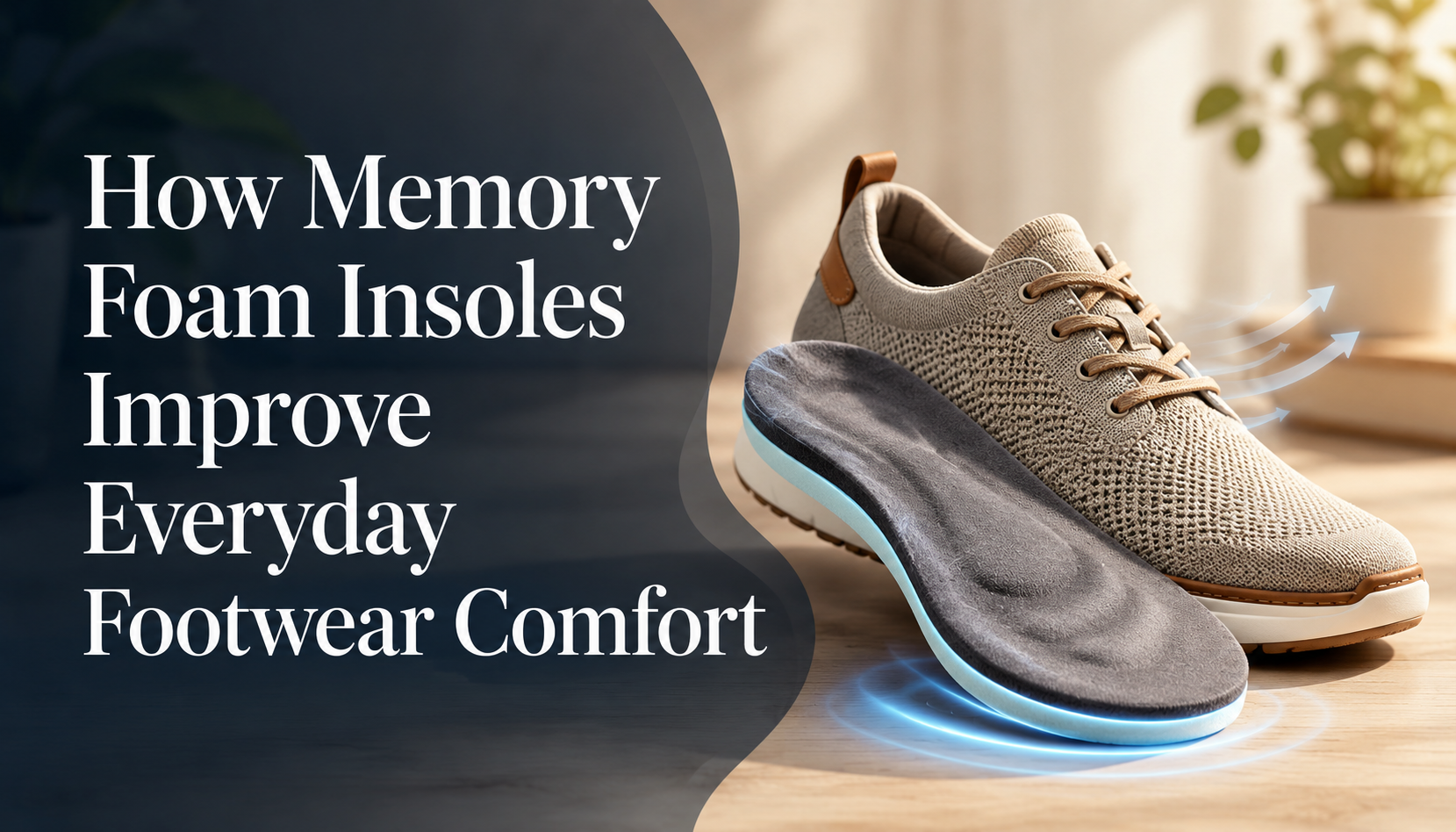
Shoes influence how the body experiences standing, walking, commuting, and working throughout the day. Even a well-designed shoe can feel uncomfortable when its internal cushioning is too thin, uneven, compressed, or poorly matched to the wearer’s routine. Memory foam insoles offer a practical way to improve the contact surface between the foot and the shoe without replacing the entire pair of footwear.
Unlike a flat insert that provides the same response across its surface, memory foam gradually reacts to pressure and follows the contours of the foot. This creates a more personalized cushioning sensation around the heel, forefoot, and other areas exposed to repeated contact. The main advantage is not softness alone, but a better balance between cushioning, fit, and everyday usability.
High-quality memory foam insoles may be used in work shoes, casual footwear, walking shoes, travel footwear, and many other daily categories. Their effectiveness depends on material quality, thickness, shoe compatibility, and the amount of space available inside the footwear.
Why Shoes Can Become Uncomfortable During the Day
Footwear may feel comfortable during the first hour and become increasingly tiring as the day continues. Repeated pressure can compress basic internal padding, while hard walking surfaces transfer more impact through the sole. Heat, moisture, poor fit, and insufficient space around the toes can also influence the overall wearing experience.
An insole cannot correct every footwear problem, but it can improve the way pressure is managed inside a compatible shoe. Memory foam creates a responsive layer between the foot and the harder structure below it. This additional cushioning can make daily movement feel smoother and reduce the harsh sensation associated with thin or worn shoe interiors.
Common reasons for declining shoe comfort include:
- Factory insoles that have become flattened or uneven
- Limited cushioning beneath the heel and forefoot
- Long periods spent standing on hard surfaces
- Shoes that allow the foot to move excessively
- Internal materials that no longer recover after pressure
- A mismatch between the shoe’s volume and the wearer’s foot shape
Before adding new insoles, the user should identify whether the problem comes from insufficient cushioning or from an unsuitable shoe size. An insert should improve the fit rather than make the shoe excessively tight.
How Memory Foam Adapts to the Foot
Memory foam responds gradually when pressure and warmth are applied. Instead of creating a rigid platform, it compresses around the foot and distributes contact across a broader surface. This can reduce the feeling that one small area is carrying most of the load.
When the foot is lifted, quality foam begins to regain its original shape. This recovery process is important because an insole that remains permanently compressed will provide less cushioning over time. Reliable shape recovery supports more consistent comfort across repeated periods of wear.
Important performance characteristics include:
- Controlled compression beneath body weight
- Gradual adaptation to the foot’s contact pattern
- Cushioning around common pressure zones
- Recovery after the shoe is removed
- Stable thickness during regular use
- Compatibility with the intended footwear category
Different formulations produce different results. Very soft foam may feel comfortable immediately but can compress too deeply, while excessively firm material may not provide the expected adaptive feeling. A balanced construction is usually more suitable for daily footwear.
Practical Benefits of Memory Foam Insoles
The most noticeable benefit is often a softer internal surface. However, premium memory foam insoles can also improve how securely the foot sits inside a shoe, especially when the original insert has lost its structure. Better contact may help reduce unnecessary movement without creating an inflexible feeling.
Memory foam can also make hard-soled footwear feel less severe during ordinary walking. It does not eliminate impact, but it can help moderate the sensation transferred through the shoe. For people who spend many hours on their feet, consistent cushioning can be more valuable than an extremely soft feeling that disappears quickly.
Potential everyday benefits include:
- A more comfortable step on firm surfaces
- Improved cushioning beneath the heel and forefoot
- A more personalized internal fit
- Less noticeable pressure from thin shoe interiors
- Better comfort during commuting and standing
- A refreshed feeling in older but structurally sound footwear
Memory foam insoles are comfort products rather than medical treatments. Persistent pain, numbness, swelling, or recurring foot problems should be assessed by an appropriate healthcare professional.
Suitable Footwear and Daily Uses
Memory foam insoles can work with many footwear categories, but they perform best when the shoe has sufficient internal room. Shoes with removable factory inserts are often easier to adapt because the original layer can be taken out before the replacement is installed.
The intended activity also matters. A person working behind a counter may prioritize sustained cushioning, while a frequent traveler may need lightweight comfort that remains practical across airports, streets, and public transportation. The right insole should support the routine without restricting the natural fit of the shoe.
Common applications include:
- Work shoes used during long standing periods
- Casual sneakers for daily walking
- Travel footwear worn for extended journeys
- Retail, hospitality, and service-sector shoes
- Light training and recovery footwear
- Everyday boots with adequate internal space
- Commuting shoes used on hard urban surfaces
Low-volume formal shoes may not accommodate a thick insert. In such cases, a thinner design or a different shoe may be more appropriate.
Choosing the Correct Thickness and Firmness
Thickness affects both cushioning and fit. A thicker insole can provide a more noticeable padded feeling, but it also raises the foot inside the shoe. This may reduce toe space, create heel pressure, or cause the foot to slip against the collar.
Firmness determines how deeply the foam compresses. Soft foam may suit users seeking a plush sensation, while medium-density foam can provide a more controlled balance for extended wear. A successful choice preserves adequate shoe space while delivering enough cushioning to remain useful throughout the day.
Consider the following before selecting an insole:
- Whether the original shoe insert can be removed
- The amount of space above the toes
- The height of the shoe around the heel
- The user’s body weight and daily activity
- The desired balance between softness and stability
- Whether the insole will be used occasionally or every day
Trying the shoe indoors before extended use helps identify fit problems early. The toes should not feel compressed, and the heel should remain securely positioned.
How to Fit Memory Foam Insoles Correctly
Some insoles are produced in exact sizes, while others are designed to be trimmed. A trim-to-fit model should be cut carefully because removing too much material can create movement or exposed areas inside the shoe. When possible, the original factory insert can be used as a sizing guide.
The insole should sit flat from heel to toe without curling at the edges. Wrinkles, folds, or forward movement can create discomfort and reduce the product’s useful life. Correct placement is essential because even premium material cannot perform properly when the insert does not fit the shoe.
A practical fitting process includes:
- Remove the existing insert when the shoe design permits
- Compare the new insole with the original shape
- Trim gradually rather than cutting to the final line immediately
- Place the heel section firmly against the rear of the shoe
- Check that the edges lie flat
- Walk indoors and reassess toe and heel space
- Repeat minor adjustments only when necessary
Users should avoid stacking several thick insoles. Multiple layers can change the shoe’s intended geometry and reduce internal space.
Care and Replacement Guidelines
Memory foam should generally be cleaned gently. Saturating the material or exposing it to strong heat may affect the foam structure, adhesives, or surface fabric. A lightly damp cloth and natural air drying are usually more appropriate than machine washing unless the manufacturer provides different instructions.
Rotating footwear allows insoles time to air and recover between uses. This can be especially useful for people who wear shoes during long shifts. Routine care supports hygiene, material recovery, and more consistent performance.
Useful care practices include:
- Remove the insoles periodically for ventilation
- Wipe the surface with a lightly damp cloth
- Allow them to dry away from direct heat
- Avoid twisting or aggressively wringing the foam
- Keep the shoe interior clean
- Rotate between footwear when practical
- Inspect the foam for permanent compression
Replacement becomes appropriate when the cushioning no longer returns, the surface is damaged, the insert moves inside the shoe, or comfort has noticeably declined.
What Defines a Premium Memory Foam Insole
Not every product marketed as memory foam provides the same level of performance. Foam density, composition, thickness, surface fabric, bonding quality, and production consistency all influence the final result. A well-designed product should provide immediate comfort without becoming unstable under pressure.
Polyurethane-based memory foam can be engineered to combine adaptation with compression recovery. FIXAR focuses on polyurethane memory foam insoles designed for everyday movement, industrial production consistency, and longer-lasting cushioning. This material-centered approach is particularly relevant for users and footwear businesses seeking dependable comfort rather than temporary softness.
Premium construction may include:
- Consistent foam density across the insole
- Controlled recovery after compression
- Durable bonding between material layers
- A surface selected for regular footwear use
- Clean cutting and stable dimensions
- A thickness appropriate for the intended shoe
- Repeatable performance across production batches
The best choice is not automatically the thickest or softest product. It is the insole that delivers the appropriate combination of comfort, fit, recovery, and durability for its intended use.
Sık Sorulan Sorular – S.S.S
1. What are memory foam insoles?
Memory foam insoles are removable footwear inserts made with pressure-responsive foam. They compress around the foot to create a more adaptive and cushioned contact surface.
2. How do memory foam insoles improve comfort?
They add cushioning between the foot and the harder structure of the shoe. Their adaptive surface may also help distribute contact more evenly across pressure-sensitive areas.
3. Are memory foam insoles suitable for standing all day?
They can improve comfort for people who spend extended periods standing, provided the shoe has enough space and the foam offers reliable recovery. Individual requirements vary according to footwear, body weight, and working conditions.
4. Can memory foam insoles be used for walking?
Yes, they may be suitable for everyday walking when they fit securely inside the shoe. The insole should not slide, fold, or make the footwear excessively tight.
5. Do memory foam insoles provide arch support?
Some designs include shaped arch areas, while others mainly provide cushioning. Buyers should examine the structure rather than assuming every memory foam product offers the same support profile.
6. Should the original shoe insole be removed?
Removing the original insert is usually preferable when it is detachable. This helps preserve internal space and allows the replacement insole to sit flat.
7. Can memory foam insoles make shoes too tight?
Yes, especially when a thick insert is added without removing the original layer. A successful fit should maintain comfortable toe space and secure heel positioning.
8. Are thicker memory foam insoles always better?
No, because additional thickness can reduce shoe volume and change the foot’s position. The correct thickness depends on the footwear design and the user’s comfort needs.
9. How long do memory foam insoles last?
Their useful life depends on foam quality, frequency of use, moisture exposure, body weight, and care. They should be replaced when cushioning remains compressed or comfort noticeably declines.
10. Can memory foam insoles be trimmed?
Trim-to-fit products can usually be adjusted with scissors. Cutting should be gradual, and the original insole may be used as a shape guide.
11. Are memory foam insoles washable?
Care instructions vary, but soaking or machine washing may damage some foam and adhesive systems. Gentle surface cleaning and natural air drying are generally safer.
12. Can they be used in work boots?
They can be used in work boots that provide sufficient internal space. The insert should not interfere with the secure fit or any safety features of the footwear.
13. Are memory foam insoles suitable for sports shoes?
They may work for light training and general athletic footwear, but sport-specific needs can require specialized structures. High-impact activities should be matched with an insole designed for that movement pattern.
14. Do memory foam insoles prevent foot pain?
They are designed primarily to improve cushioning and comfort, not to diagnose or treat medical conditions. Persistent or severe pain requires professional assessment.
15. Why does compression recovery matter?
Recovery allows the foam to regain thickness after pressure is removed. Better recovery supports more consistent cushioning during repeated wear.
16. Can one pair be moved between different shoes?
Yes, when the shoes have similar internal shapes and enough room. Frequent transfer can be inconvenient, so dedicated pairs may provide a more reliable fit.
17. Do memory foam insoles help older shoes?
They may refresh comfort when the original insert is worn but the shoe remains structurally sound. They cannot repair damaged soles, collapsed uppers, or incorrect sizing.
18. Are memory foam insoles suitable for travel?
They can be useful for long journeys that involve extended walking, standing, or waiting. Travelers should test them before departure rather than using a new fit for the first time during a trip.
19. What is the difference between cheap and premium memory foam?
Premium foam generally offers more controlled compression, better recovery, and greater production consistency. Lower-quality material may feel soft initially but flatten more quickly.
20. How should I choose the right memory foam insole?
Consider shoe volume, activity, thickness, firmness, material quality, and whether the original insert is removable. The final choice should improve comfort without restricting the foot.
Bir yanıt yazın